a conducting object through which a direct connection to earth is established defines what?
By Jack Smith
Why must a facility electrical system have a practiced electrical footing? In addition to being required by the National Burn down Protection Association (NFPA) and the Occupational Safety Health Assistants (OSHA), and recommended by the Institute of Electric and Electronics Engineers (IEEE), American National Standards Institute (ANSI), and the International Electrotechnical Commission (IEC), a well-grounded system increases electrical safety and decreases the odds of equipment harm or failure.
The National Electrical Code (NEC) provides specific requirements for both utility-provided electrical service and separately derived systems. A separately derived organization receives ability from a source of electrical energy or equipment other than the utility service. This column volition address certain aspects associated just with grounding utility-provided electrical service.
Definition of terms
Commodity 100 of the NEC includes definition of terms essential to the proper application of the code. The post-obit electrical organisation grounding definitions are from Part I of Commodity 100:
- Basis: The earth.
- Grounded: Connected to basis or to a conductive body that extends the ground connection.
- Grounded conductor: A arrangement or excursion conductor that is intentionally grounded.
- Equipment grounding conductor: The conductive path (or paths) installed to connect normally non-electric current-carrying metal parts of equipment together and to the system grounded conductor or to the grounding electrode usher, or both. Information technology is recognized that the equipment grounding conductor besides performs bonding.
- Grounding electrode: A conducting object through which a direct connection to world is established.
- Grounding electrode conductor: A conductor used to connect the system grounded conductor or the equipment to a grounding electrode or to a bespeak on the grounding electrode system.
Grounding connections
A premises wiring organization supplied by a grounded ac service must have a grounding electrode conductor connected to the grounding service conductor. The connection must be made at an attainable point from the load end of the service driblet or service lateral to the terminal or double-decker to which the grounded service usher is connected at the service disconnect. Service drop refers to overhead conductors; service lateral refers to cloak-and-dagger conductors.
If the transformer supplying the service is located outside the building, at least one additional grounding connectedness must exist made from the grounded service usher to a grounding electrode - either at the transformer or elsewhere outside the building. For services that are dual fed in a common enclosure or grouped together in separate enclosures and use a secondary tie, a unmarried grounding electrode conductor connection to the tie point of the grounded conductors from each power source is allowed.
While earth grounding involves an intentional connexion from a circuit or organisation usher to a ground electrode placed in the earth, equipment grounding connects the equipment housing or cabinet to a grounding electrode. This excursion or system conductor typically refers to the neutral conductor. Article 250.26 of the NEC specifies which usher is to exist grounded for ac premises wiring systems:
| Organisation wiring configuration | Conductor to exist grounded |
|---|---|
| Single-phase, two-wire | One conductor |
| Unmarried-phase, three-wire | Neutral conductor |
| Measured V | (Amps) |
| Multi-phase systems with i wire common to all phases | Mutual usher |
| Multi-phase systems where ane phase is grounded | One phase conductor |
| Multi-phase systems where one phase is grounded 1 phase conductor | Neutral usher |
Exposed, normally not-current-carrying metal parts of stock-still equipment supplied by or enclosing conductors or components that are likely to become energized must be connected to an equipment grounding conductor if the operating equipment:
- Has any terminals with more than 150 5 to ground
- Is located in a moisture or damp expanse and non electrically isolated
- Is subject area to human contact
- Is supplied past a wiring method that provides an equipment grounding conductor
Earth basis
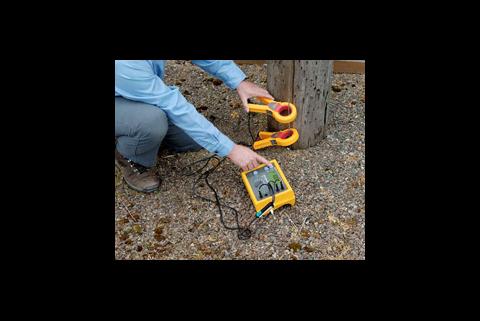
Properly grounding a facility's electric organisation ensures a low impedance connexion from the electrical system to the earth. However, the effectiveness of the earth ground depends on several factors. While the ground electrode placed into the globe should be highly conductive, actual basis resistance depends on the length and depth of the ground electrode placed into the earth, the diameter of the electrode, the bodily number of electrodes, the grounding arrangement design, and the actual resistivity - or electrical conductivity - of the soil.
The degree to which soil conducts electricity is both variable and complex. Soil depth affects resistivity, which typically decreases as depth increases. Deep electrode placement can reduce earth basis impedance as can using multiple electrodes. Other factors affecting soil resistivity include soil composition, mineral content, settling and/or compression, temperature (resistivity increases as temperature decreases), and the presence (or absenteeism) of metal objects buried in the soil (such as tanks or pipes).
Because grounding electrodes are subject field to oxidation and corrosion and because of the potential for soil resistivity to vary, the integrity of the ground electrode should be tested periodically. Earth grounding systems can be tested using earth basis testers such every bit models Fluke 1621, Fluke 1625 and Fluke 1623, and Fluke 1630 bachelor from Fluke. Globe footing testers measure ground resistivity by applying a voltage to the electrode and measuring the resulting electric current. Fluke offers a great bargain of information about earth footing testing on its website.
Endmost the loop
I take been writing this cavalcade for more than than two years. All the same, this is my final "Solid Ground" column for Fluke, equally I am embarking on another endeavor. CFE Media LLC has appointed me as editor of Applied Automation, a bimonthly supplement to Control Technology and Establish Engineeringmagazines, beginning with the August 2012 issue.
As I wrote in my first cavalcade, I want to extend a big "thanks" to Fluke for inviting me to write this cavalcade. I take enjoyed writing every one of them. I will truly miss information technology.
Moving forward, I urge yous to proceed standing on "Solid Basis."
Source: https://www.fluke.com/en-us/learn/blog/electrical/maintaining-a-solid-ground
0 Response to "a conducting object through which a direct connection to earth is established defines what?"
Post a Comment