Organic Free Range Beef Orange County
en Español
El inglés es el idioma de command de esta página. En la medida en que haya algún conflicto entre la traducción al inglés y la traducción, el inglés prevalece.
Al hacer clic en el enlace de traducción se activa united nations servicio de traducción gratuito para convertir la página al español. Al igual que con cualquier traducción por Internet, la conversión no es sensible al contexto y puede que no traduzca el texto en su significado original. NC State Extension no garantiza la exactitud del texto traducido. Por favor, tenga en cuenta que algunas aplicaciones y/o servicios pueden no funcionar como se espera cuando se traducen.
English is the controlling language of this page. To the extent there is any disharmonize between the English language text and the translation, English controls.
Clicking on the translation link activates a free translation service to convert the folio to Spanish. As with any Net translation, the conversion is not context-sensitive and may non interpret the text to its original meaning. NC State Extension does not guarantee the accuracy of the translated text. Please notation that some applications and/or services may not function as expected when translated.
Collapse ▲
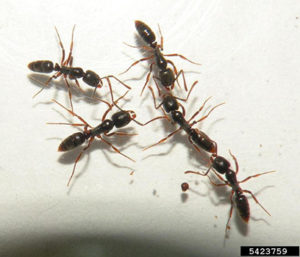
Asian needle ant workers
Though first reported in the United States in the early on 1930s, Brachyponera chinensis, commonly known as the Asian needle ant, has only been recognized as a pest here since 2006. Native to Asia, this introduced pismire has at present been documented in North Carolina, as well as Alabama, Florida, Georgia, Due south Carolina, Tennessee, Virginia, Connecticut, and New York. This species is an unusual pest considering unlike pest ants such as the fire ant and the Argentine ant associated with areas that have been disturbed past human activity, the Asian needle pismire is able to nest in both disturbed and "natural areas" like forests. This emmet has been found in various settings from school cafeterias to residential lawns to logs in State and National Parks.
The Asian needle emmet poses a triple threat to humans. Commencement, its venomous sting is painful, and on average, somewhat more likely to cause an allergic reaction than the venom in a honey bee's sting. As a effect, people allergic to insect stings should take special intendance to avert stings when in an Asian needle ant-infested area.
The second emerging bear on posed by the Asian needle ant is its ability to infest homes. Their colonies are much smaller in population size than more commonly recognized business firm pest ants similar the Argentine emmet or the odorous house ant. However, the Asian needle pismire has increasingly been found pilfering food from school cafeterias and residential kitchens. While having ants crawling on food is a nuisance, the primary threat is the increased likelihood of people beingness stung.
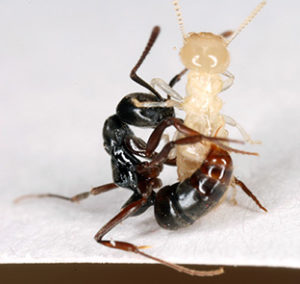
Asian needle ants prey on termites and other insects
The third, and potentially greatest, negative bear upon posed by the Asian needle emmet is its potential to devastate a natural environment past excluding native ant species and termites. Our native ants play essential roles in maintaining the status quo of the forest ecosystem and Asian needle ants either directly eat them, consume their food, or accept over their nest sites. When the Asian needle pismire eliminates the native species or reduces their affluence, many roles, like seed dispersal and predation of forest pests, are left unfilled.
IDENTIFICATION
The Asian needle ant is a medium-to-small-sized ant, with workers and queens measuring v.0 to half-dozen.5 mm (1/5″) in length. That means workers are smaller than carpenter or wood ants (Camponotus spp. or Formica spp.) merely larger than "sugar ants" (Linepithema humile or Tapinoma sessile). Workers and queens are very similar in appearance. Individuals are relatively long and slender, dark chocolate-brown to black in color, with legs and mandibles that are a lighter brown to orangish-ish color.
Asian needle ants can as well be distinguished from other ants considering they have an inability to cling to smoothen surfaces like glass. Past advisedly capturing an Asian needle ant in a drinking glass jar, one tin can discover that, unlike other ants that will climb the sides of the jar, the Asian needle emmet volition brand a few futile attempts to climb earlier circumscribed itself to the base of the jar.
Biological science
This species prefers to nest in moist, clammy areas like the insides of rotting logs, leafage litter, below rocks, and in loose soil, but will as well nest in man-made structures, like around sprinkler systems and within pavement crevices. Colony size tin can vary from relatively minor (tens of individuals) to big (thousands of individuals). Colony territories may range from several nests around the base of a single tree to several nests in a few adjacent logs along the wood floor. Their colonies are "polydomous" pregnant that one colony consists of several nests. They are also "polygynous" which means the nests have several queens at the same time. The number of queens decreases over the summer when alate (winged) ants are produced.
The Asian needle pismire apparently prefers termites every bit a food source but has been plant scavenging on a variety of arthropods and other invertebrates such as crane flies, crickets, cockroaches, beetles, grasshoppers, collembolans ("springtails"), spiders, centipedes, world worms and other dead organisms. This species as well directs colony members to saccharide sources similar apple jelly and scavenges food particles from human being trash bins.
While they are not aggressive every bit are fire ants and generally try to abscond contact with humans, they will sting when pressured. The majority of stings from Asian needle ants occur when humans accidentally place their hands in nests or on ants, applying force per unit area to the pismire that evokes a defensive sting. Because of this, information technology is wise to wear thick gloves when treatment mulch, moving debris or placing i's mitt in night areas that might be infested by Asian needle ants.
Command
Now, there is no formalized management recommendation. However, because this species is predatory and scavenges on invertebrate carrion, it has been noted that they will recruit to poly peptide-based insecticide baits. Professional products such as Extinguish Plus®,Advion® Fire Ant Bait, Optigard® and Maxforce FG ® are suitable baits for this pest. For homeowners, some of the fire ant baits such as "Amdro", should work. It is important to think in terms of *management* rather than eradication.
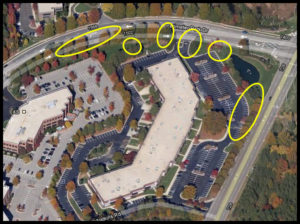
Asian needle emmet handling zones
Before treating:
- Check the surface area carefully andostend that you are dealing with Asian needle ants.
- Designatetreatment zones where you see active foraging ants (rather than but scatter bait everywhere on the holding which tin reduce the likelihood that ants will find and collect the bait).
- Care for each designated zone co-ordinate to the allurement product's characterization directions.
- Spend a few minutes observing whether the ants visit and collect the bait.
- Check the area for continued needle ant activeness in iii-4 weeks and re-treat areas where you see activity (Note: some production labels may restrict the number of applications per season).
- Starting your treatments in April (IF emmet activity is observed) may assistance reduce the affect of baiting on not-target pismire species.
Other References:
Nelder, Marking P.; Paysen, Due east.S.; Zungoli, P. A.; Benson, Due east. 2006. Emergence of the introduced ant Pachycondyla chinensis (Formicidae: Ponerinae) as a public health threat in the southeastern United States. Journal of Medical Entomology, Volume 43, Number 5. pp. 1094-1098(5). [abstract]
Guénard, Benoit & R. Dunn. 2010. A New (Former), Invasive Ant in the Hardwood Forests of Eastern North America and Its Potentially Widespread Impact. PLoS 1 five(7): e11614. doi:10.1371/journal.pone.0011614. [article]
Patricia A. Zungoli & E.P. Benson. 2006. Seasonal Occurrence of Swarming Activity and Worker Abundance of Pachycondyla Chinensis. Proceedings of the 6th International Conference on Urban Pests. [article]
Prepared past Eleanor Spicer Rice and Mike Waldvogel
Recommendations for the utilize of pesticides are included in this publication as a convenience to the reader. The use of make names and any mention or listing of commercial products or services in this publication does non imply endorsement by North Carolina Cooperative Extension nor discrimination against similar products or services not mentioned. Individuals who use pesticides are responsible for ensuring that the intended employ complies with electric current regulations and conforms to the product label. Be sure to obtain current data about usage regulations and examine a electric current product characterization before applying any chemical. For aid, contact your county Cooperative Extension agent.
Source: https://entomology.ces.ncsu.edu/asian-needle-ant/
0 Response to "Organic Free Range Beef Orange County"
Post a Comment