Dry Air Aged Beef in Loxley Al

Beefiness aging (American English) or ageing is a process of preparing beef for consumption past aging it, in order to intermission down the connective tissue inside the meat.
Dry-anile beefiness [edit]

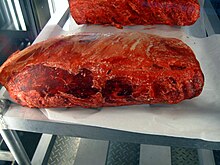
Dry out-aged beef is beef that has been hung or placed on a rack to dry for several weeks. Later on the creature is slaughtered and cleaned, it is hung equally a total or half carcass. Primal (large singled-out sections) or sub key cuts, such as strip loins, rib eyes, and sirloin, are placed in a fridge unit, also known every bit a "hot box". This process involves considerable expense, as the beef must exist stored nigh freezing temperatures. Subprimal cuts tin can exist dry aged on racks either in especially climate-controlled coolers or inside a moisture-permeable drybag. Moreover, only the college grades of meat tin can be dry aged, as the process requires meat with a large, evenly distributed fat content. Because of this, dry-aged beef is seldom available outside of steak restaurants and upscale butcher shops or groceries. The key effect of dry crumbling is the concentration and saturation of the natural flavor, besides every bit the tenderization of the meat texture.
The process changes beefiness by 2 ways. Firstly, wet is evaporated from the muscle. The resulting process of desiccation creates a greater concentration of beef flavour and sense of taste. Secondly, the beefiness's natural enzymes pause downwards the connective tissue in the muscle, which leads to more tender beef.
The process of dry-aging usually likewise promotes growth of certain fungal (mold) species on the external surface of the meat. This does not cause spoilage, only rather forms an external "crust" on the meat'south surface, which is trimmed off when the meat is prepared for cooking. These fungal species complement the natural enzymes in the beef past helping to tenderize and increase the flavor of the meat. The genus Thamnidium, in particular, is known to produce collagenolytic enzymes which greatly contribute to the tenderness and season of dry-aged meat. [1]
Dry-aged beef is typically non sold by well-nigh supermarkets in the U.S. today, because it takes fourth dimension, the meat loses weight, and there is a take a chance of spoilage. Dry-aging tin have from fifteen to 28 days, and typically up to a third or more of the weight is lost as wet. This type of beefiness is served in higher-priced steakhouses and past select restaurants.
Dry-crumbling can be done at dwelling house under refrigeration by iii means: open air, with the presence of salt blocks, and with the apply of a moisture permeable drybag to protect the meat while it is crumbling. Since the mid-2010s, some chefs take experimented with a "quick" or "cheat" dry-age by coating a cut of beefiness with ground koji (rice inoculated with Aspergillus oryzae) to simulate the effect of traditional dry out-aging; the results are not quite the aforementioned, but tin can be achieved within 48 to 72 hours.[ii] The koji technique can also exist applied to chicken and shrimp.[three]
When dry aging using a moisture permeable textile, surface mold growth is non present, flavor and scent exchange within the refrigerated environment is not a concern, and trim loss of the outer hardened surface is measurably reduced.[four] The season and texture profile of the beef is like on all dimensions to the traditional open air dry out-aged results.
Historically, it was common to store mutton or beef joints at room temperature for extended periods; even afterward the invention of refrigeration hanging sides of beef in large coolers for a few weeks equally function of the processing was standard.[five]
Moisture-anile beef [edit]
Wet-aged beef is beef that has typically been anile in a vacuum-sealed purse to retain its moisture. This is the dominant mode of aging beefiness in the U.South. and UK today. It is popular with producers, wholesalers and retailers because it takes less fourth dimension: typically only a few days and in that location is no moisture loss, so any given piece of meat sold by weight will have a higher value than a dry aged piece where moisture loss is desired for sense of taste at the expense of final weight. The beef is normally kept for a menstruum of four to x days in wet aging. Modified-atmosphere packaging (MAP) is usually employed for the vacuum packaging of meat; typically between threescore and 80 per centum oxygen to retain its appetizing color, with red meat such as beef needing a higher oxygen level than less vividly colored meat such as pork. The vacuum packed beef is stored at a temperature of 32 °F to 45 °F (0 °C to 7.2 °C).
Meet also [edit]
- Ham, peculiarly state ham: pork crumbling, Bacon
- Meat hanging
References [edit]
- ^ "Dry Aged Steak: Why Dry Age Meat?". Retrieved 6 August 2021.
- ^ Leone, Brad (16 March 2016). "The Dry-Age Shortcut: How to False 45 Days in 48 Hours". Bon Appétit . Retrieved 7 October 2018.
- ^ Leone, Brad (26 Apr 2017). "Brad Uses Moldy Rice (Koji) to Brand Nutrient Delicious". It's Alive! With Brad. Flavour one. Episode 6. YouTube. Bon Appétit. Archived from the original on 2021-12-22. Retrieved 7 October 2018.
- ^ DeGeer, S. L.; Hunt, M. C.; Bratcher, C. L.; Crozier-Dodson, B. A.; Johnson, D. Eastward.; Stika, J. F. (2009). "Spotlight on dry aging beef: Furnishings of loin type, crumbling methods, and aging time". Kansas State University. Agronomical Experiment Station and Cooperative Extension Service. Retrieved 2013-03-14 .
- ^ Semley, John (18 August 2017). "Approaching bovinity: Life, death and the existential understanding that comes from dry-aged beef". The National Mail service . Retrieved 18 August 2017.
Farther reading [edit]
- Ahnström, M. L.; Seyfert, One thousand.; Chase, M. C.; Johnson, D. E. (2006). "Dry aging of beef in a bag highly permeable to water vapor". Meat Science. 73 (4): 674–679. doi:10.1016/j.meatsci.2006.03.006.
- DeGeer, S. L.; Hunt, M. C.; Bratcher, C. L.; Crozier-Dodson, B. A.; Johnson, D. E.; Stika, J. F. (2009). "Effects of dry aging of bone-in and boneless strip loins using two aging processes for two crumbling times". Meat Scientific discipline. 83 (iv): 768–774. doi:10.1016/j.meatsci.2009.08.017.
External links [edit]
- "Almost EVERYTHING You Need To Know About Dry Aged Beef!". Enquire The Meatman.
- http://world wide web.modifiedatmospherepackaging.com/applications/modified-atmosphere-packaging-fresh-meat.aspx
Source: https://en.wikipedia.org/wiki/Beef_aging
0 Response to "Dry Air Aged Beef in Loxley Al"
Post a Comment